
The primary purpose of the Charter is to advance a quality education for children and youth that is grounded in Indigenous culture.
The following information is to provide further clarity to the primary purpose of the Charter. The Kenaitze Indian Tribe’s vision is:
To assure Kahtnuht’ana Dena’ina thrive forever.
And mission:
By 2033, the Kahtnuht’ana Dena’ina have enhanced and strengthened the prosperity, health, and culture of their people and Tribe.
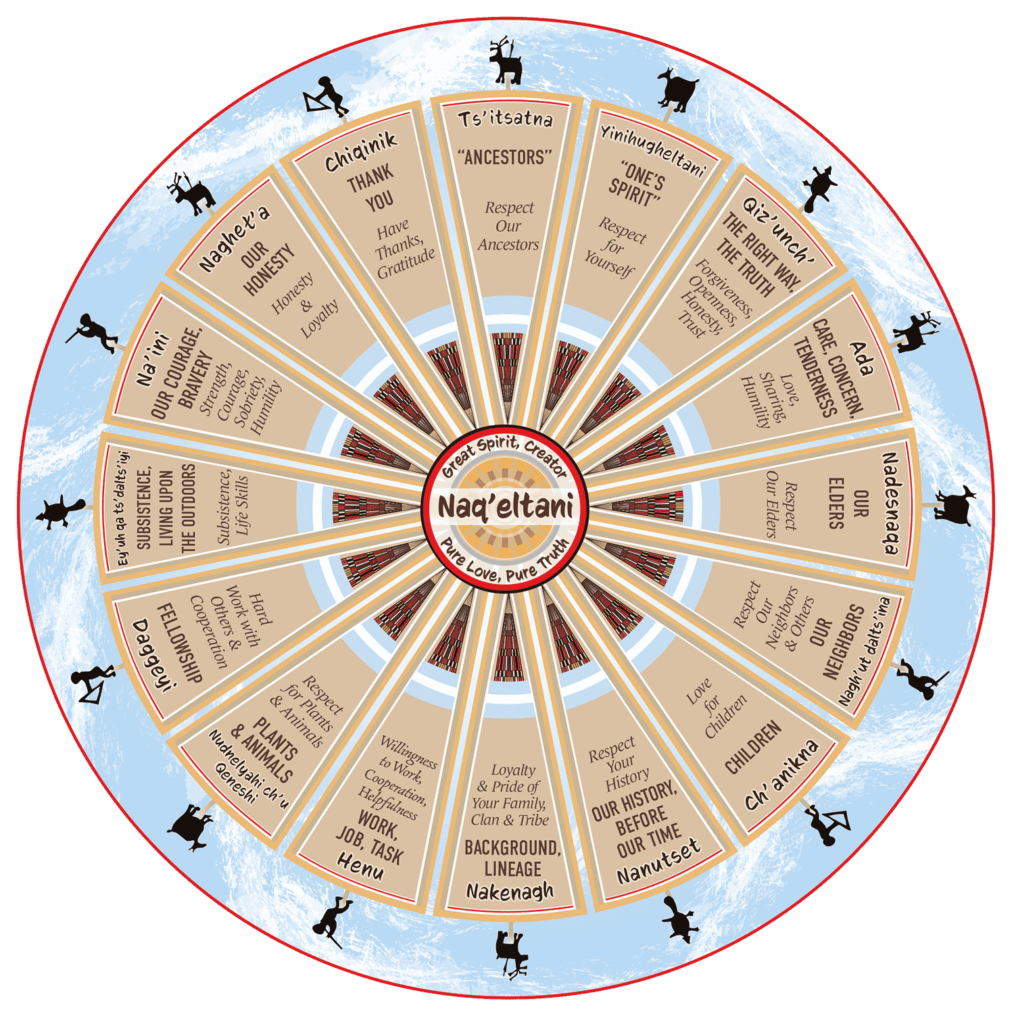
The Traditional Values of the Kenaitze Indian Tribe help define the Kenaitze people and assure the future. Translated from Dena’ina, these values are:
- Naq’eltani – “Great Spirit, Creator, Pure Love, Pure Truth”
- Ts’itsatna – “ancestors”
- Yinihugheltani – “one’s spirit”
- Qiz’unch’ – “the right way, the truth”
- Ada – “care, concern, tenderness”
- Nadesnaqa – “our Elders”
- Nagh’ut dalts’ina – “our neighbors”
- Ch’anikna – “children”
- Nanutset – “our history, before our time”
- Nakenagh – “background, lineage”
- Henu – “work, job, task”
- Nudnelyahi ch’u qeneshi – “plants and animals”
- Daggeyi – “fellowship”
- Ey’uh qats’dalts’iyi – “subsistence, living upon the outdoors”
- Na’ini – “strength, courage, sobriety, humility”
- Nagheł’a – “our honesty”
- Chiqinik – “thank you”
The mission and vision of the Tribe will be reflected in the charter school’s purpose and unique approach to education including the school’s mission, vision, and goals.
The school will constitute a unique blend of educational options for families that will draw from Alaska Native and American Indian cultural learnings and ways. Our charter school will strive to provide culturally rich curricular options for students in environments that respect and honor indigenous students and their families. The school will build a solid foundation of culturally responsive education programs that will be offered through several options including on-site learning, experiential and place-based learning, and at-home and community partnerships. The school will strive to offer culture-rich education opportunities throughout all programs. Students will have access to supplemental enrichment and educational opportunities on and off the school’s campus to support all those enrolled in our programs.
The Charter’s school name, mission, vision, and goals:
The name of the school will be Tułen Charter School, which is Dena’ina for “the current is flowing” or “the river will flow”. This name demonstrates the value of the Kenai River to the Kenaitze people and symbolizes the flowing of knowledge, culture, language, and values to our students.
Vision:
Our vision is to be a beacon for educational excellence and cultural pride for the Kenai Peninsula. We envision a school where the richness of Dena’ina cultural heritage is interwoven into every aspect of learning, fostering a deep sense of belonging, pride, and self-confidence. We strive to develop resilient, culturally grounded individuals who are prepared to lead and inspire positive change within our community and beyond.
Mission:
To provide a culturally based, academically rigorous education that empowers duhdeldihen (“students”) to succeed in today’s world by embracing Dena’ina traditional values, language, culture, and to develop responsible community members who are critical thinkers, compassionate, and committed to living the Dena’ina culture.
Goals:
- To address historical and intergenerational trauma by empowering Dena’ina practices that foster healing.
- Integrate Dena’ina language, values and culture into the school curriculum starting in the first academic year with ongoing assessments and adjustments to ensure effective learning of these three components.
- Recruit and train qualified instructors to become language speakers in Dena’ina, develop language learning resources, and establish regular language practice and cultural activities.
- Foster a strong sense of identity and pride rooted in Dena’ina cultural traditions and values through engagement of families and community partners.
- Develop and implement place-based learning curriculum that incorporates traditional ecological knowledge, outdoor and experiential learning, and environmental stewardship activities
- Provide an academically rigorous education through the utilization of integrated STEAM activities and curriculum.
- Maintain small class sizes that emphasize relationship based practices where the curriculum meets the student.
- Implement on-going student progress monitoring assessments to inform instruction and make data-informed decisions.
- Establish an intergenerational mentorship model where students provide guidance to peers to create a sense of community and support while developing leadership skills for all students.