


Native Youth Leaders Council
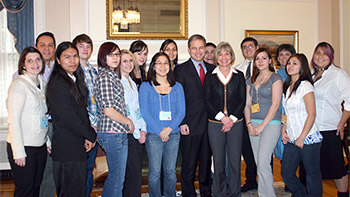 |
| Members of the Native Youth Leaders Council from the Kenai Peninsula Borough School District meet with Gov. Sean and Sandy Parnell at the Governor's Mansion in Juneau, as part of the Close-Up program in February. |
When students visit their state or national capital for the Close-Up program, the purpose is for them to see their government in action. For students with the Native Youth Leaders Council from the Kenai Peninsula Borough School District, their trip to Juneau from Feb. 6 to 11 had an extra meaning. Not only were they getting a close-up view of how their state government functions, they were focusing on the type of government they’d like to create for themselves.
This is the first year of the Native Youth Leaders Council in KPBSD, a group of about 15 students from schools with Title VII Native education funding, but its purpose has been a longtime goal — fostering interconnection, collaboration and leadership between Native students throughout the far-flung school district.
Students from 14 Title VII schools across KPBSD were eligible to apply for the program, and needed to demonstrate good grades, responsibility, maturity and other evidence of leadership ability to be chosen to participate. About a dozen students met for the first time in November in the central peninsula, and participated in a few days of collaborative, get-to-know-you activities. The next meeting in January focused on setting up a constitution and bylaws for the organization.
That process hit an unexpected hiccup as the students realized their traditional, cultural model of decision-making clashed with the more regimented model typical of municipal governance.
“One of the concerns the kids have is they come from more of a consensus-based leadership, with roundtable decisions made by consensus, rather than our American system of Roberts Rules of Order,” said Teresa Kiffmeyer, program coordinator.
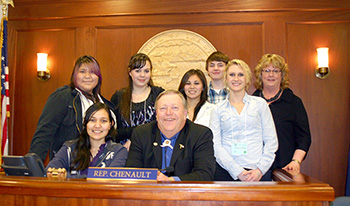 |
| Members of the Native Youth Leaders Council from the Kenai Peninsula Borough School District meet with Speaker of the House Mike Chenault, R-Nikiski, during a visit to the Alaska Legislature in Juneau, as part of the Close-Up program in February. |
“That became daunting. Here we have kids from nine different schools all over the place and we’re just trying to figure out the first step of how the kids want to run this council. But the Close-Up people said, ‘Well, great. Why don’t you work on that? That can be the project you present,’” Kiffmeyer said.
With that in mind, students took to Juneau seeking input and perspective on not only Alaska government, but on the type of governmental structure they’d like to use for their own council. It was a busy trip, Kiffmeyer said, with students visiting lawmakers, Native leaders and legislative sessions during the day, and meeting at night to discuss their bylaws, vision statement and constitution.
“The kids just learned so much, just about how they want to do it, from seeing their Native corporation, how their tribes do it, to how the United States does things,” she said.
Students met with Kenai Peninsula lawmakers as well as Native representatives from all over the state The Alaska Federation of Natives was meeting in Juneau while Close-Up was there.
“They ended up being invited to the AFN board meeting. They were introduced to the board and the president of AFN (Julie Kitka) told the students she would come to one of their meetings, and Sen. (Albert Kookesh, of Angoon) said he would be very interested in coming and helping them. They made some really awesome connections when they were in Juneau,” Kiffmeyer said.
Close-Up students also attended a reception at the Governor’s Mansion and visited with Gov. Sean Parnell. The KPBSD Native students didn’t let the opportunity go to waste.
“Most of the questions came from our kids, and a lot of the really awesome questions came from the kids in those Native villages,” Kiffmeyer said. “They were very articulate. It’s been just a really eye-opening experience.”
The council will have another meeting this spring, where students will continue work on formulating the group’s structure and vision statement, and plan for next year. Kiffmeyer said she wants the group to expand next year, to include students in grades 10 through 12, and spread word of the organization throughout Title VII schools, as well as their communities.
“We’ve never done this in the district before. It’s kind of happening as it’s happening and we’re figuring it out as we go along,” Kiffmeyer said. “I couldn’t have hoped for more. I’m really happy with where the kids are at and how the kids have grown.”